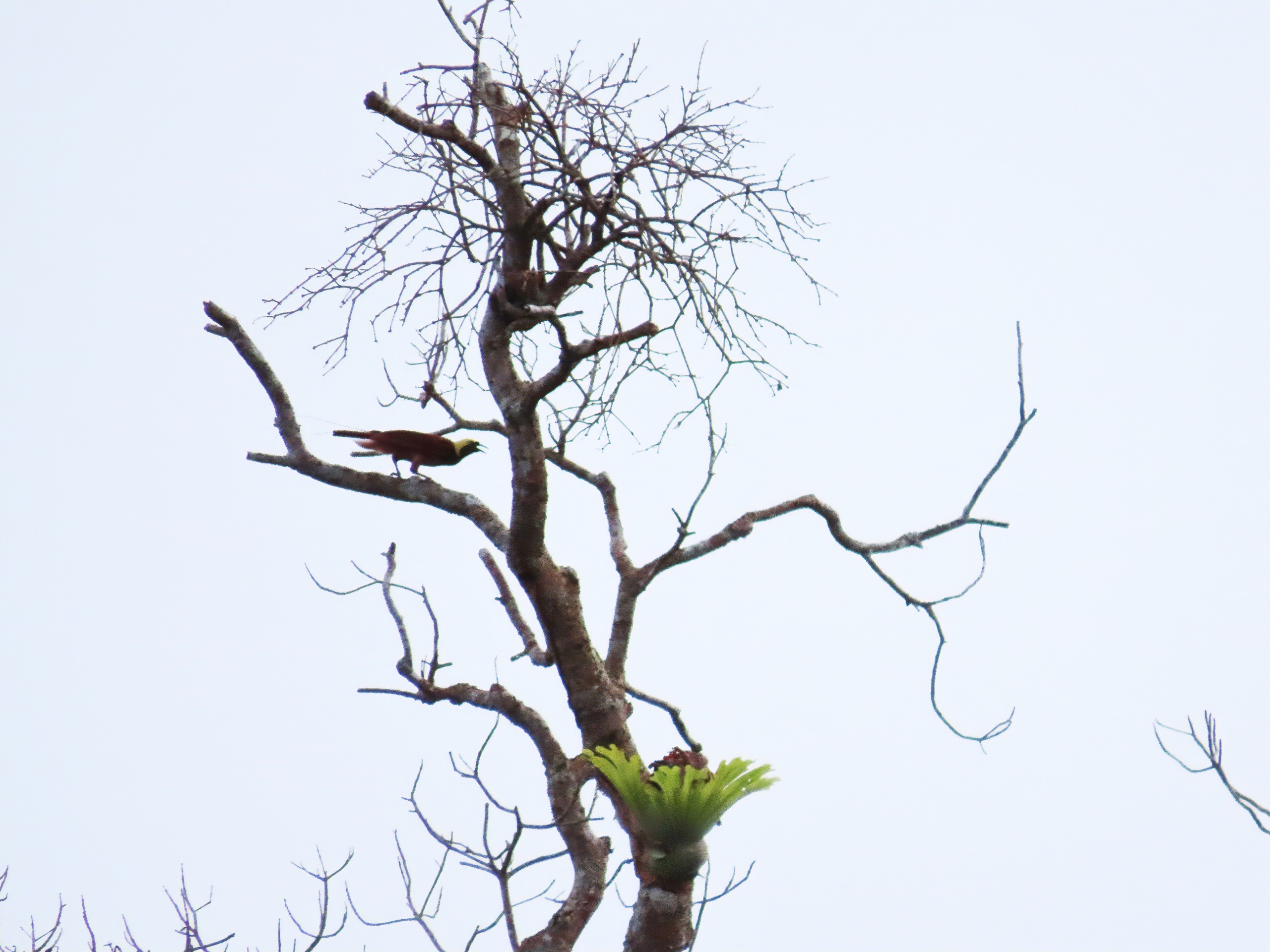
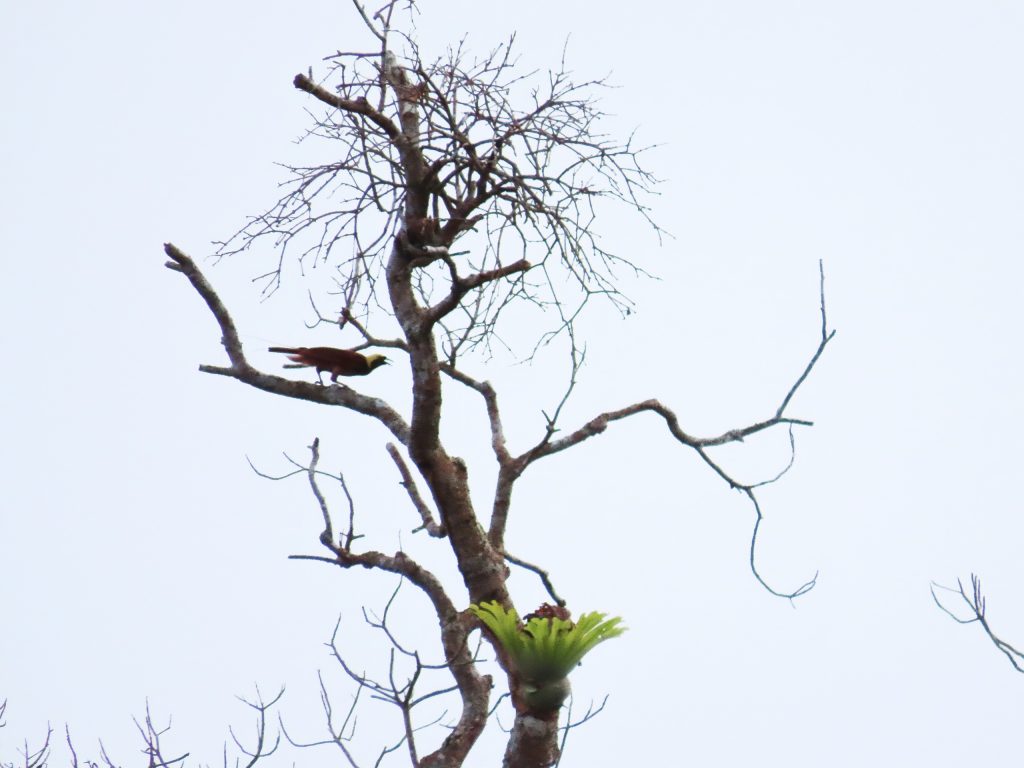
Photo: A portrait of the Greater Bird-of-Paradise captured by the IPB University research team. Fruiting trees constitute a vital component of the Greater Bird-of-Paradise (Paradisaea apoda) habitat, serving as one of its primary food sources.
SOUTH PAPUA – The existence of the Greater Bird-of-Paradise (Paradisaea apoda) is inextricably linked to habitat conditions that provide diverse food sources, ranging from forest fruits, nectar, and seeds to arthropods and occasionally small animals.
Among these diverse sources, fruits represent a crucial food source for the Greater Bird-of-Paradise. This motivated IPB University, in collaboration with TSE Group, to conduct research on the types of fruiting trees utilized as food sources by the Greater Bird-of-Paradise.
In a study published in an international journal titled “Fruiting Tree Used by Greater Bird-of-Paradise (Paradisaea apoda) in Logging Concession in South Papua,” Dr. Ir. Yeni Aryati Mulyani M.Sc., Prof. Dr. Ani Mardiastuti, M.Sc., and their team successfully identified six tree species utilized as food sources by the Greater Bird-of-Paradise within the concession area.
“Two of these, namely Myristica inspida and Oncosperma tigillarium, were identified through direct observation. Meanwhile, the other four species, which are Calophyllum soulattri, Ficus obliqua, Myristica fatua, and Syzygium sp., were identified based on indirect evidence,” the journal stated.
These six tree species generally exhibit a clustered distribution pattern. Furthermore, these trees possess vegetation structure characteristics that support the foraging activities of the Bird-of-Paradise, including dense canopies and extensive branching.
The journal also noted that the availability of various fruiting tree species is essential because the Greater Bird-of-Paradise must adapt to the seasonal availability of fruit. The presence of multiple fruit-bearing tree species allows this bird to utilize different food sources in accordance with the prevailing conditions and availability within its habitat.
These findings also demonstrate an interrelation between the habitat requirements of the Bird-of-Paradise and vegetation management within the concession area. Notably, Calophyllum soulattri and Myristica fatua, which were identified as food sources for the bird, are commercial timber species.
This condition renders an understanding of the presence of food source trees a critical aspect of managing the habitat of the Greater Bird-of-Paradise. However, the study also noted that available data remains limited. A significant portion of the records regarding tree utilization was obtained through indirect evidence; thus, further research and monitoring are required to substantiate these findings.
The research team from IPB University noted that, as an initial step, the management of the Greater Bird-of-Paradise habitat could be directed toward maintaining vegetation heterogeneity and habitat structure, particularly along riparian buffer zones. This area is recognized as a location with a high concentration of foraging activities by the Greater Bird-of-Paradise.
Long-term monitoring also constitutes a crucial component of these efforts. Continuously acquired data can assist in determining whether vegetation changes resulting from forest management activities impact the distribution patterns of the trees serving as food sources for the Bird-of-Paradise.
Consequently, this research not only provides insights into the tree species utilized by the Greater Bird-of-Paradise but also serves as a foundation for understanding the interconnections between food source availability, habitat structure, and forest area management.
For TSE Group, these findings will serve as a key reference in wildlife habitat management within the concession area. Efforts to preserve vegetation diversity and conduct consistent monitoring are expected to help ensure the availability of a habitat that supports the sustainability of the Greater Bird-of-Paradise in South Papua. (PR)