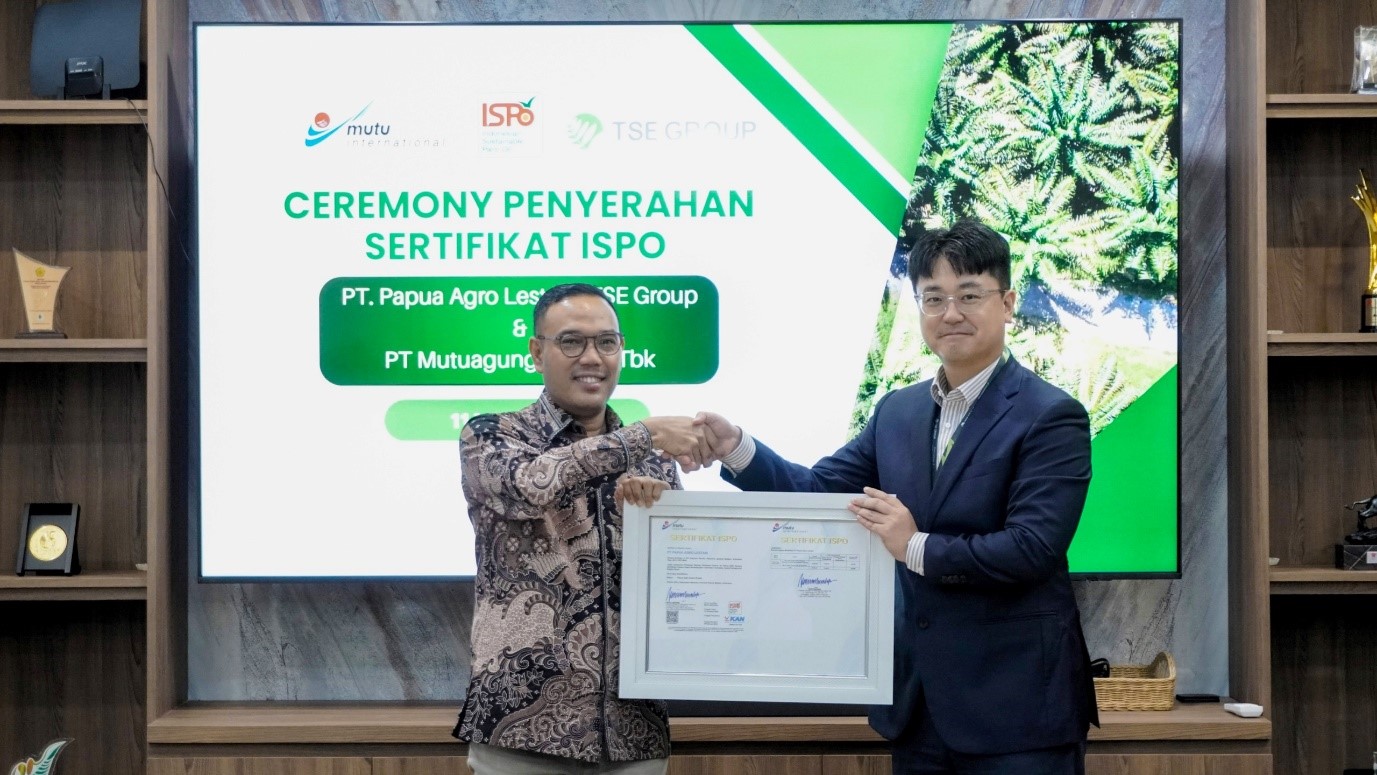

Photo: TSE Group director Woo Sangjo attended the 2023 Sawit Indonesia Award on behalf of the company in Jakarta, Wednesday (12/20).
JAKARTA – Sawit Indonesia Magazine returned with 2023 Sawit Indonesia Award at Borobudur Hotel, Jakarta, Wednesday (12/20). The publication bestowed accolades to a total of 55 stakeholders across social circles and professions in the palm oil industry, from ministries, local governments, enterprises, farmers, academicians, government agencies, higher education institutions, to palm oil supporting industries.
Winners are judged based on their track record on the news, especially regarding their programs and policies, Sawit Indonesia Award committee head Qayuum Amri explained. Like last year, the award’s internal evaluation process hinged on three aspects: communication, information, and commitment.
“There are 55 awardees, just like last year. But this time, we have a few new awards that we feel are worth giving to some of these winners for their dedication,” said Amri, who’s also the editor-in-chief of Sawit Indonesia.
Tunas Sawa Erma (TSE) Group was among the recipients of these prestigious awards. This year, the company came out as a winner for “The Most Reputable Palm Oil Company On Public Health Services” category for its contribution to health quality improvements in Papua.

PHOTO 2023 Sawit Indonesia Award certificate. TSE Group comes out as a winner for “The Most Reputable Palm Oil Company On Public Health Services” category for its contribution to health quality improvements in Papua.
Health issues in Papua and mainly Asiki (Boven Digoel Regency) has been a prime focus of the company for years. Through its CSC (Corporate Social Contribution) programs, TSE Group strives to enhance health quality by sending doctors and medical staff to remote areas, where they give health classes and free treatment to local communities.
At each of the company’s plantation blocks, there are clinics that locals may access for free. A modern health facility called the Asiki Clinic was also established in the inlands, where this 1,100 m2 building offers extensive facilities including out- and inpatient wards, a delivery room, perinatology unit, ER, minor procedure room, ultrasound room, pharmacy, and ambulance services.
Asiki Clinic doesn’t only provide medical services and treatment; it runs a number of programs that improve community health, raise awareness of a clean and healthy lifestyle, and lower maternal and newborn deaths. On a regular basis, the Clinic holds vaccinations with the help of local health services to protect babies from dangerous diseases.
Through social contribution programs like the ones above, the palm oil industry has grown into one that brings goodness to everyone. Dida Gardera, deputy for food and agribusiness coordination of the Coordinating Ministry for Economic Affairs, said at the event that Indonesia currently possesses 16.38 million hectares of oil palm plantations. Among them, one million goes to the state, 6.8 million to the common people and 8.6 million to the private sector. “The entire land produces 51 million tons of oil palms, of which 12 million tons are consumed and the rest are exported internationally.”
Despite this, huge challenges await, especially those touching on sustainability. There is now the European Union Deforestation Regulation or EUDR, which poses a major obstacle to Indonesia in establishing the presence of its palm oil products on the global market.
Gardera called on all businesses, farmers, and relevant stakeholders to ensure the success of the ISPO certification program. “While oil palm [trade] is making positive impacts, it comes with hurdles. One of the requirements [of EUDR] is traceability, which isn’t easy to fulfil. But we, the government and stakeholders, are doing this because of our own needs and not external demand. One [reason], is to boost the productivity and welfare of farmers and local companies.” (PR)