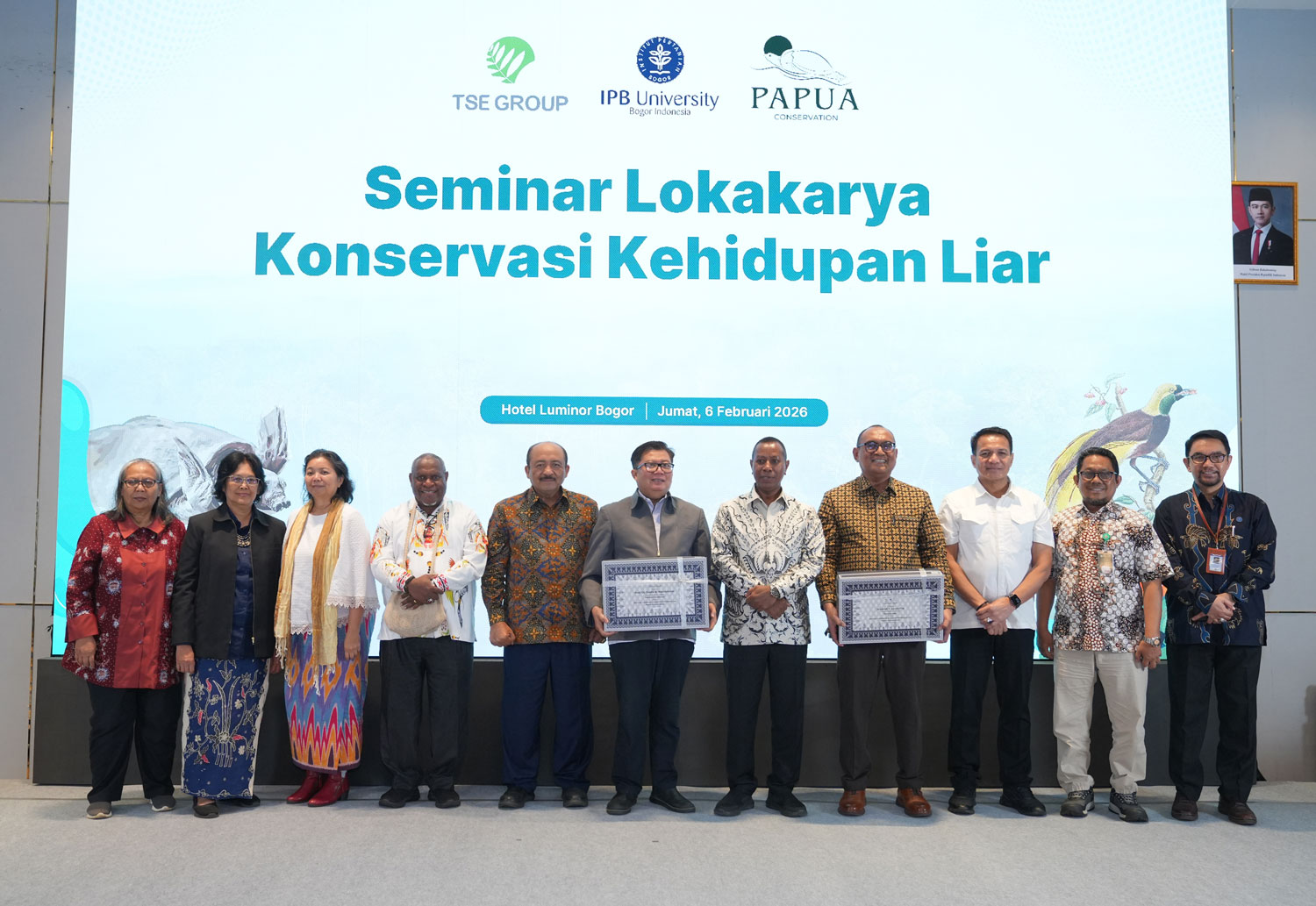
This event is attended by IPB University’s bird-of-paradise and pig-nosed turtle research teams, South Papuan Governor Apolo Safanpo, South Papua’s Papua’s People Assembly Chairman Damianus Katayu, National Research and Innovation Agency (BRIN) officials, management authorities, academicians, and Indonesian Palm Oil Association members
BOGOR — Despite climate changes, the responsible management of production forests and riverscapes continues to help protect pig-nosed turtle and greater bird-of-paradise homes in Papua, said a four-year joint research between IPB University and Tunas Sawa Erma (TSE) Group.
This finding was made public at “Melindungi Ikon Papua: Pemantauan Jangka Panjang Kura-kura Moncong Babi dan Cenderawasih” (Preserving Papua’s Icons: Long-Term Observation of Pig-Nosed Turtles and Birds-of-Paradise), a wildlife conservation seminar and workshop held Friday (2/6/2026) in Bogor. The event was part of a long research project conducted by IPB University and TSE Group since 2022.
Another point highlighted consistent occurrences of greater birds-of-paradise (Paradisaea apoda) within TSE Group’s production forests, where selective harvesting is practiced. Throughout the study, over 100 birds were identified across two forest concessions, with half of the area showing high levels of habitat suitability.
Authors have also found success in documenting lekking (mating) events, and recognizing lek and food-producing trees that are key to the species’ longevity.
Prof. Ani Mardiastuti — in charge of the greater birds-of-paradise research — said forest management practices that maintain high conservation value (HCV) areas and employ selective harvesting contribute to endemic bird preservation in Papua.
“Responsibly-managed production forests remain capable of supporting the lives of birds-of-paradise, and even hold potential for birding ecotourism.”
Meanwhile, on the freshwater front, a close examination of the pig-nosed turtles revealed climate change as an increasingly defining factor for the species’ breeding success.
Extreme precipitation and flooding on the Kao River have caused spawning failure in multiple observation sessions, underscoring the need for conservation strategies that rely both on habitat safeguarding and climate adaptation.
Pig-nosed turtle researcher, Prof. Mirza D. Kusrini, emphasized the importance of long-term monitoring in studying the effects of weather anomalies on animal life cycles.

Prof. Mirza D. Kusrini, Prof. Ani Mardiastuti, and Dr. Yeni A. Mulyani speaking on pig-nosed turtle, greater bird-of-paradise, and herpetofauna research conducted by IPB University’s Forestry and Environment Faculty and TSE Group
“Prolonged observations are crucial for understanding weather anomaly impacts on breeding success. By working with locals, we can ensure conservation efforts continue unabated.”
From a business perspective, this research establishes stronger foundations for accountable forest management practices. TSE Group’s Director Wicklief F. Leunufna affirmed local environmental and wildlife preservation as part of the company’s commitments.
“Through our research collaboration with IPB University, we aim to continuously align our operations with evidence-based conservation.”
This seminar slash workshop featured a cross-sectoral discussion forum that identified opportunities and obstacles to long-term observation. The segment also suggested science-based policy and technical recommendations for protected wildlife management in Papua.
IPB University’s Forestry and Environment Faculty Dean, Prof. Dodik Ridho Nurrochmat, hoped to see their study being referenced in future regional policymaking.

The seminar is part of IPB University and TSE Group’s accountability reporting in regard to this long research project
“We hope this forum becomes a platform for knowledge exchange, as well as stakeholder input and mandate to keep our research aligned with needs for actionable policies.”
South Papuan Governor Apolo Safanpo, also in attendance, said data-driven research is central to public policy decisions. Credible studies ensure development decisions and natural resource management are carried out with respect to the people and planet, he added.
Altogether, IPB University and TSE Group’s joint project covers wildlife population monitoring, HCV area protection, and technical recommendation development for managing key species. Its results are expected to serve as a valuable reference for local governments, businesses, and other stakeholders in strengthening wildlife and broader ecosystem conservation in Papua, especially in the face of climate change pressures. (*)