
Photo: Greater birds-of-paradise (Paradisaea apoda, Linnaeus, 1758) (Taken by Marcellia/ Pacific Conservation Biology Journal)
BOVEN DIGOEL – Tunas Sawa Erma (TSE) Group continues to expand conservation initiatives in Papua through the Papua Conservation program developed with IPB University. One of their works is a study on the distribution and condition of habitat for greater birds-of-paradise in the forests of Boven Digoel Regency, South Papua.
The research team identified roughly 79,901 hectares of habitable land, which make up 12% of the observation site (678,313 hectares). Of this figure, 47,673 hectares (or 60%) are part of PT Tunas Timber Lestari and PT Inocin Abadi’s concession areas. Both companies fall under the Korindo Group umbrella.
This study was published as “Habitat Suitability and Lekking Habitat Use of the Greater Bird-of-Paradise (Paradisaea apoda) in Human-Modified Landscapes of Papua” in an international journal on October 30, 2026. It was authored by six researchers from the Faculty of Forestry and Environment at IPB University — Lilik Budi Prasetyo, Aryo Adhi Condro, Azwar Azmillah Sujaswara, Ani Mardiastuti, Yeni Aryati Mulyani, and Arif Kurnia Wijayanto — under a partnership with TSE Group.

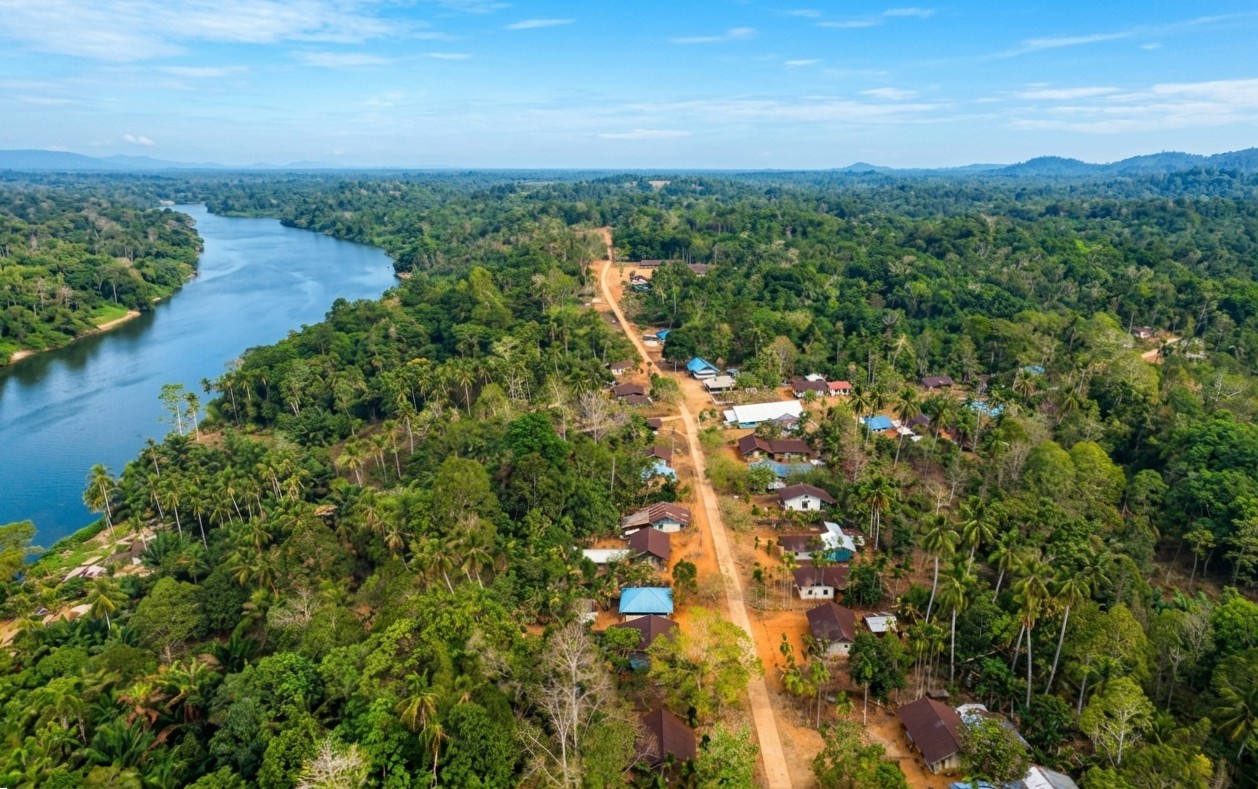
Photo: The site chosen for habitat suitability research. It’s part of PT Tunas Timber Lestari and PT Inocin Abadi’s concession areas in South Papua Province, Indonesia. Road network © contributors of OpenStreetMap, available under the license of Open Database License (ODbL)
Data collection spanned from 2022 to 2023, during which the research team observed the birds firsthand, listened for calls, and located trees used for breeding. Over the two-year period, they recorded 59 encounters.
The team worked closely with local field guides and other members of local communities who are familiar with the observation site. Beyond the forests, these partners possess knowledge of the species’ whereabouts.
From the findings, TSE Group obtained key information to help identify the habitats in its operational locations and understand their current conditions.
One notable discovery is the places greater birds-of-paradise flock to — and how environmental conditions differ between where they do daily activities and where they procreate. Breeding individuals are more drawn to intact forest patches marked by tall, lush canopies and minimal human interference, but generally, the birds can be found even in moderately disturbed areas.
This finding may have to do with their mating ritual, where displays by male birds take place on trees designated as mating sites.
The study noted that trees in the preserved ecosystems have an average height of 31.59 meters, compared with those in more-modified landscapes, or where non-mating activities occur (29.01 meters). The former also tends to be densely packed.
Researchers emphasized that although occurrences of greater birds-of-paradise were recorded in moderately disturbed environments, this doesn’t mean all forest conditions support their reproduction. Habitats with tall trees, a diverse canopy structure, and lower levels of anthropogenic disturbance remain vital in this process.
Yet, production forests are still integral to wildlife conservation. By retaining mature trees and forest cover, they provide a place to live for the greater birds-of-paradise. This is bearing in mind that such landscapes don’t fully replace the functions of natural forests, particularly as breeding grounds.
To support protection efforts, researchers recommended creating a minimum buffer of 250 meters around mating trees. This method aims to minimize human-induced disturbances during breeding and in general.
Other important measures include safeguarding natural forest patches and emergent trees, as well as connecting fragmented habitats. Reforestation using native Papuan species is also encouraged to help restore forest conditions.
In this way, the study marked another milestone in TSE Group and IPB University’s Papua Conservation partnership. Aside from supplying information on habitat locations and conditions, it helps the company recognize which concession areas are in need of greater attention for wildlife conservation.
Its results are expected to inform TSE Group’s forest management strategies going forward, especially those related to wildlife habitat and environmental sustainability. Through collaborations with the academic community, the company promotes initiatives that balance business operations and biodiversity preservation in Papua. (PR)